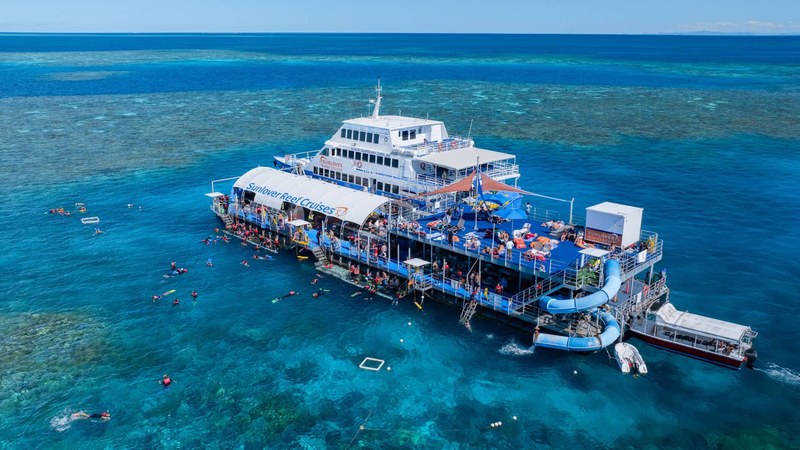
Great Barrier Reef Cruises from Cairns
Every type of vessel, honest 2026 pricing and — most importantly — what happens when your trip is cancelled
Cairns is the main gateway to the Great Barrier Reef and the busiest marine market in Australia. Dozens of vessels leave the port every morning, from multi-level pontoons carrying 300 people to sailing yachts taking 25. Choosing blind is close to impossible, and the prices differ by a factor of two.
The second problem is cancellations. One company pulling its trip because of the wind while the boat at the next berth sails happily is completely normal in Cairns. We work with all the major fleets at once, so when a trip is cancelled we find a same-day replacement — usually on a larger vessel that shrugs off that wind.
Four types of reef trip
The difference between operators is usually not the quality of service but the concept of the day itself. Here is the honest comparison.
| Type of trip |
Who it suits |
Main advantages |
Limitations |
| Stationary pontoons |
Families, non-swimmers, mixed groups |
Infrastructure: underwater observatory, semi-submersible, glass bottom boat, helipad. Maximum stability on the water |
One location all day, high concentration of visitors — up to 250-300 people |
| Dive boats and catamarans |
Confident swimmers, certified divers |
Two or three different reef sites in a day, high mobility, the skipper follows the best visibility and current |
Nothing to do between swims if you stay dry. Higher risk of seasickness |
| Sailing catamarans |
Couples, small groups, a quieter day |
Few passengers on board, eco credentials, the sailing itself is part of the experience |
Longer transit means less time on the reef. Most wind-dependent, first to cancel |
| Island trips |
Families with toddlers, budget travellers |
Short 45-minute transfer, beaches and rainforest, flexible timing |
Inner reef: visibility 5-10 m instead of 15-30 m, less coral diversity |
What the reef looks like
Click a photo to enlarge.
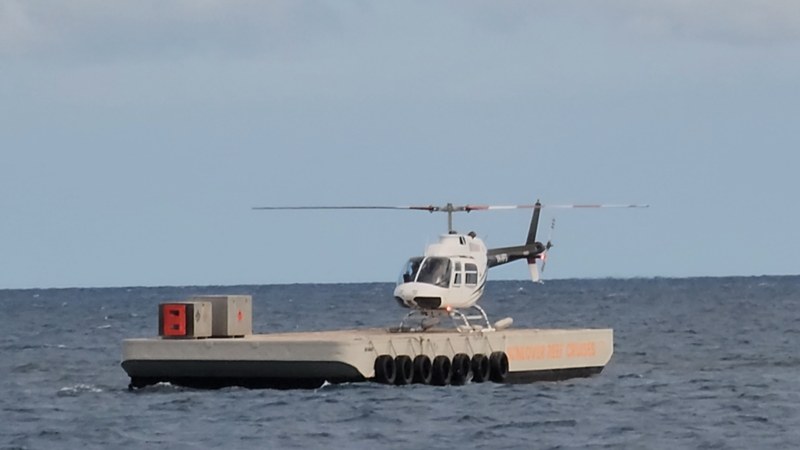
Helipad beside the Sunlover pontoon on Moore Reef — scenic flights cost extra
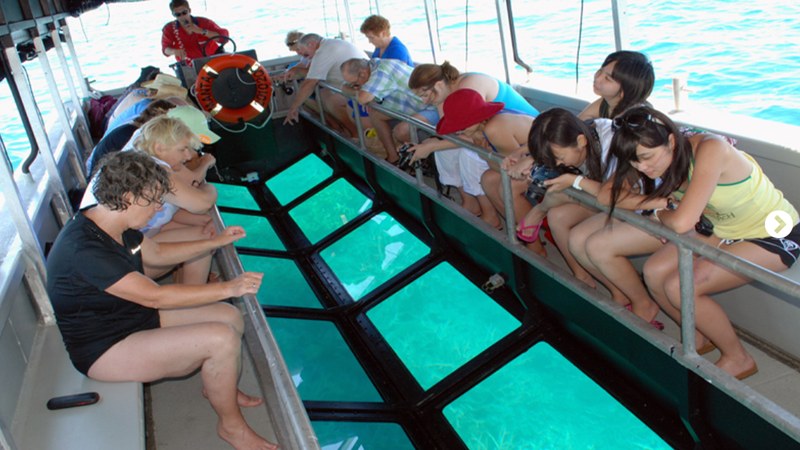
Glass bottom boat — the reef for anyone who stays dry
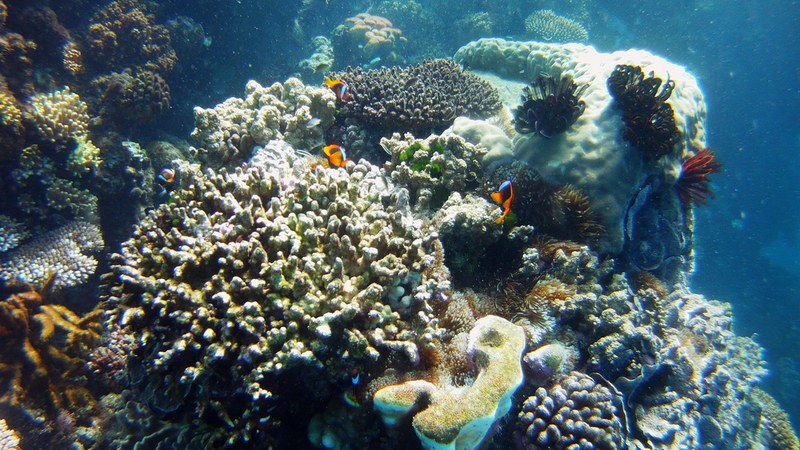
What you see through a mask: coral gardens and clownfish on the outer reef
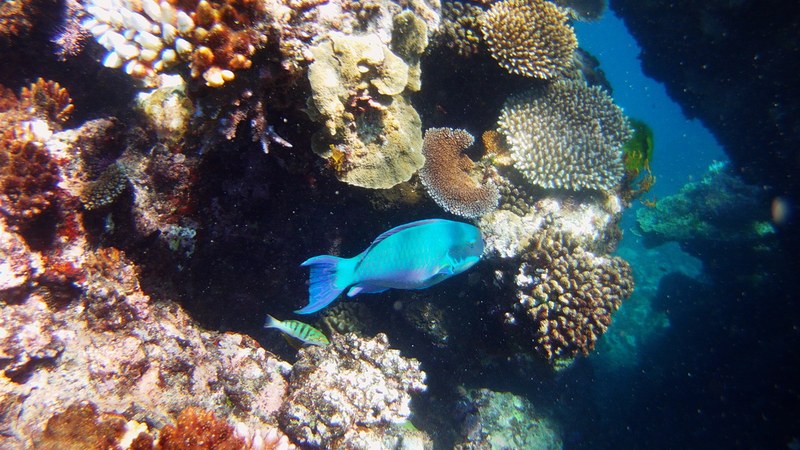
Parrotfish — a regular resident of the coral gardens
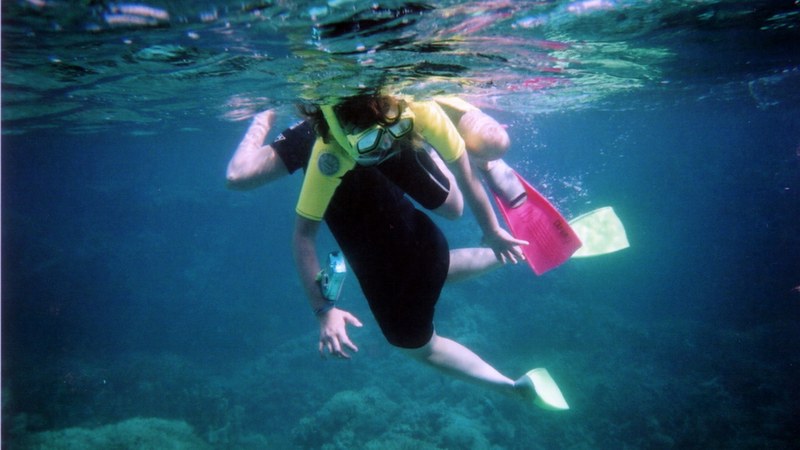
Snorkelling in a stinger suit — supplied on board during stinger season
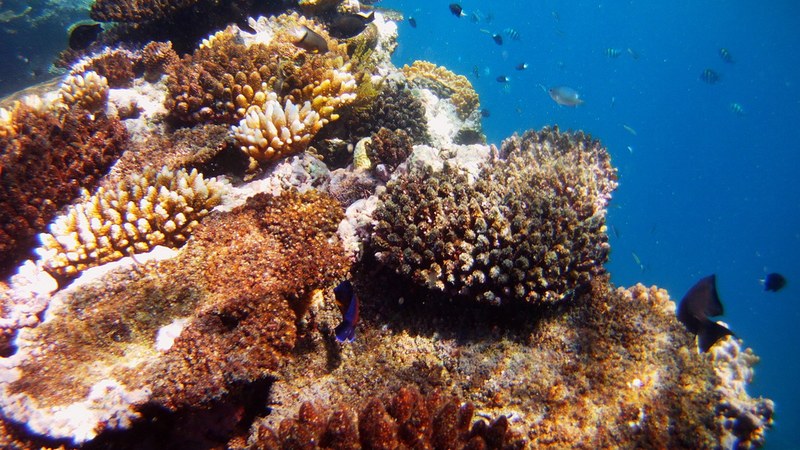
The coral wall drops away into the blue, with schools of fish along the edge
Why one boat sails and another cancels
The deciding factor is wind strength and swell, not rain. Wind in the Coral Sea is measured in knots, and it determines directly which hull goes out and which stays at the wharf.
under 15 knotsCalm seas, every vessel sails without exception. Excellent underwater visibility and a comfortable crossing.
15-20 knotsA normal tropical winter (May to August) with south-easterly trade winds. Noticeable movement on open water. The reef acts as a breakwater, but it is only truly calm inside the lagoon behind the crest — the water around the pontoon and on the approach can be quite lively in that wind.
20-30 knotsThe crossing becomes extreme. Small sailing catamarans and monohulls carrying 20-40 passengers cancel. Larger vessels — the 35-metre superyacht Evolution, the wave-piercing catamarans — keep working.
The practical conclusion: if you are in Cairns for one or two days and cannot afford a wasted slot, book a large vessel or a pontoon — the odds of the trip going ahead are noticeably better. A sailing yacht is a good choice when you have a few days up your sleeve.
What to do when your cruise is cancelled
If the operator cancels because of a strong wind warning, dangerous tides or a mechanical fault, you are always offered a choice: a full refund, or a free transfer to another date or another vessel. In that case we immediately look for a same-day replacement so the day is not lost.
If you cancel. For individual bookings of up to 14 people operators ask for 18 to 24 hours' notice for a full refund. Cancelling with less than a day to go counts as a no-show and is charged at 100%. For groups of 15 or more the threshold moves out to 72 hours, and during school holidays it can reach 7 days.
There is no refund if you miss the boat because your own flight was delayed, if you fall ill without a medical certificate, or if you simply change your mind. Unused dives are not refunded either, whether you decided against them on board or the instructor declined you on medical grounds. Travel insurance for this kind of trip is not a formality.
Worth knowing: there are many brand names at the terminal, but a number of vessels belong to the same companies. Moving from a cancelled trip to another boat under the same ownership is the fastest route and costs you nothing — that is where we start when we look for your replacement.
What it actually costs
The budget outer reef trip under A$200 no longer exists — inflation and rising insurance premiums after the cyclone seasons took care of that. In 2026 a full-day outer reef trip runs roughly A$300-360 per person, with the cheapest dive boats from about A$196. On top of that come the compulsory charges that many websites only reveal at checkout.
| Charge |
Where it applies |
Adult / child |
How it is collected |
| EMC — environmental charge |
All commercial tours, full day |
A$8.50 (aged 4 and over) |
Usually included in the online fare |
| EMC, half day |
Shorter programmes |
A$4.25 |
Included in the fare |
| Fuel levy, outer reef |
Quicksilver, Great Adventures, Silverswift, Sunlover |
A$10.00 / A$5.00 |
At booking or at check-in |
| Fuel levy, islands |
Sunlover (Fitzroy), Great Adventures (Green Island) |
A$4.00 / A$2.00 or none |
Added automatically |
| Fuel levy, helicopters |
Scenic flights from the pontoon |
A$10.00 - A$40.00 |
At booking |
| Stinger suit |
Most operators, November to May |
about A$10.00 |
Hired on board, often included on premium trips |
The Environmental Management Charge is a government levy that funds reef protection, ecosystem monitoring and crown-of-thorns starfish control. It is GST-free and operators remit it directly to the marine park authority. From 1 April 2027 the rates rise to A$9.00 for a full day and A$4.50 for a half day. Operators change fares and levies, so we confirm the exact total when we book.
Operator comparison: prices, pros and cons
Below are indicative 2026 prices per adult for a full day, the strengths and weaknesses of each option, the volume of TripAdvisor reviews and our own assessment of value for money. Operator pricing is seasonal and changes — we confirm the final figure at the time of booking.
| Operator |
Type |
2026 adult fare |
TripAdvisor reviews |
Our value-for-money rating |
| Passions of Paradise | Sailing catamaran | from A$269 | ~3,700 | ★★★★★ |
| AquaQuest | Dive catamaran | from A$196 | moderate | ★★★★★ |
| Evolution (Down Under Cruise & Dive) | 35 m superyacht | ~A$275 | moderate | ★★★★☆ |
| Ocean Spirit | Sailing vessel | ~A$288 | moderate | ★★★★☆ |
| Silverswift | Dive catamaran | ~A$308 | high | ★★★★☆ |
| Sunlover Reef Cruises | Moore Reef pontoon + Fitzroy Island | ~A$307-317 | ~1,100 | ★★★★☆ |
| Reef Magic | Pontoon, Moore Reef | A$315-360 seasonal | ~3,100 | ★★★★☆ |
| Great Adventures | Norman Reef pontoon + Green Island | ~A$312-322 | ~890 | ★★★☆☆ |
| Quicksilver (Port Douglas) | Wave-piercing catamaran, Agincourt | ~A$338 | high | ★★★☆☆ |
Prices are indicative, taken from operator and reseller sources in August 2026, and exclude the fuel levy (A$10 adult / A$5 child, payable on the day of travel). The EMC is normally already included. The value-for-money column is our own assessment based on what the fare includes and what reviewers report — it is not an official platform rating.
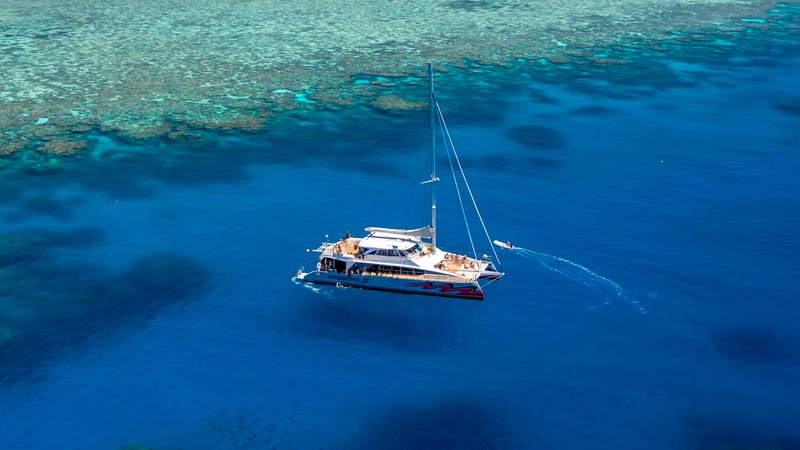
Passions of Paradise from A$269
A sailing catamaran visiting two reef sites, with eco certification and a role in citizen science programmes.
- The largest base of positive reviews among the major operators
- Few people on board; guests are treated as guests, not as a number
- The lunch draws more praise than on competing boats
- One of the lowest fares for the outer reef
- Sail power is more wind-dependent, so a higher chance of cancellation
- Longer transit leaves slightly less time on the reef
Best for: couples and anyone who wants real contact with the crew rather than a conveyor belt. ★★★★★
Sunlover Reef Cruises ~A$307-317
One of the rare trips that combines an outer reef pontoon and a tropical island, Fitzroy, in the same day — with most operators it is one or the other. It also carries the richest activity list on the platform.
- Two formats in one day: the outer reef from a pontoon and a rainforest island with a beach
- Waterslide straight into the ocean, children's pool, semi-submersible, glass bottom boat
- Helipad on the pontoon — a scenic flight over the reef with no separate transfer
- More to do for the same money than a single-location pontoon
- The programme is packed — the day is tight, so pick your priorities in advance
- Busy on the platform in high season: book the submersible and the flight as soon as you arrive
Best for: families, and anyone with a single day in Cairns who wants both the reef and an island. ★★★★☆
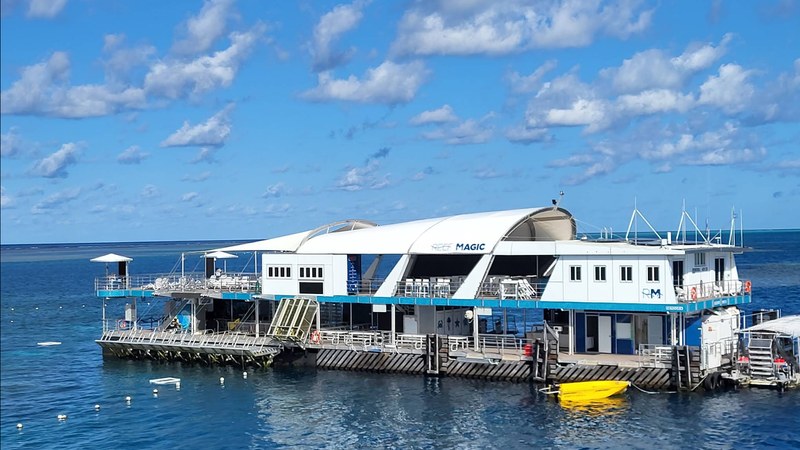
Reef Magic A$315-360
The newest platform on the reef, built in 2022, with solar panels, wind turbines and a research laboratory.
- The large pontoon stays stable even in choppy water
- New equipment and a clean vessel; the crew is regularly singled out
- Works for non-swimmers: observatory, submersible, glass bottom boat
- Peak season, late June to October, carries the highest fare
- The whole day is spent at one location
- The lunch draws occasional criticism — a limited choice of seafood
Best for: families and anyone nervous about swell who still wants the full outer reef. ★★★★☆
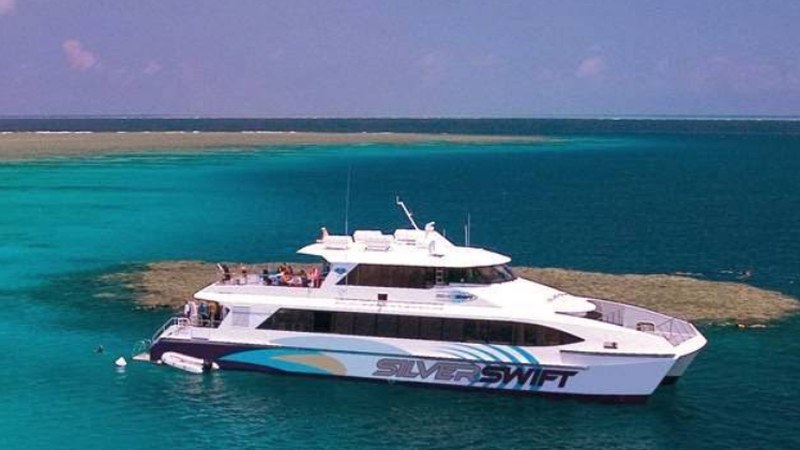
Silverswift ~A$308
A dive catamaran visiting three different reef sites in a single day.
- Three locations instead of one — the widest variety of coral
- Strong dive team; even beginners report feeling safe
- The skipper picks sites by visibility and current
- Certified dives cost roughly A$88 extra
- Nothing to do out of the water, no pontoon facilities
- More movement than on a platform
Best for: confident swimmers and divers who come for the water itself. ★★★★☆
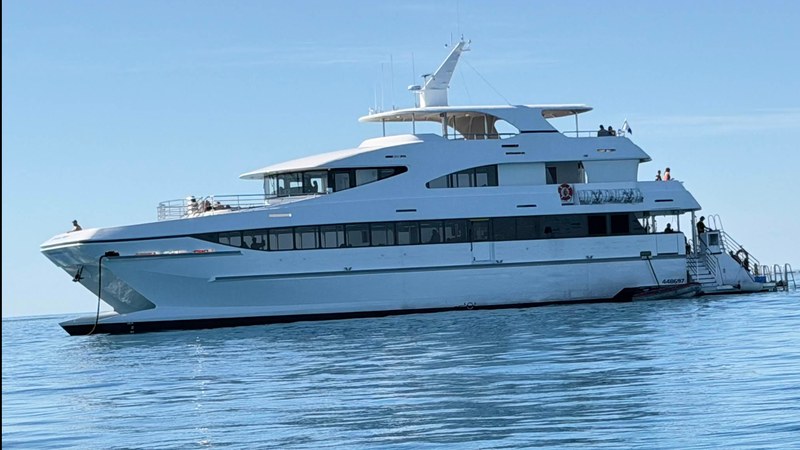
Evolution — Down Under Cruise & Dive ~A$275
A 35-metre superyacht run by an independent family business of thirty years' standing.
- Size and hull design let her sail in wind that cancels the small boats
- Fast crossing, so more time on the reef
- Noticeably cheaper than the premium catamarans
- An independent operator has no reserve fleet — a breakdown means looking elsewhere for a replacement
- Two reef sites rather than three
Best for: anyone with one day for the reef and no room for a cancellation. ★★★★☆
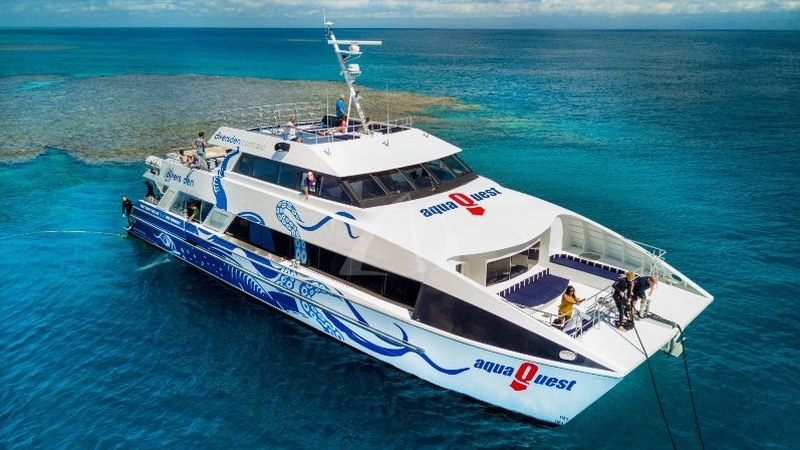
AquaQuest from A$196
The most affordable way onto the outer reef among the Cairns dive catamarans.
- Well below market price for a genuine outer reef day
- Focused on diving and snorkelling without the trimmings
- Simpler service than the premium operators
- No facilities for non-swimmers
Best for: budget travellers and divers who want water time, not service. ★★★★★
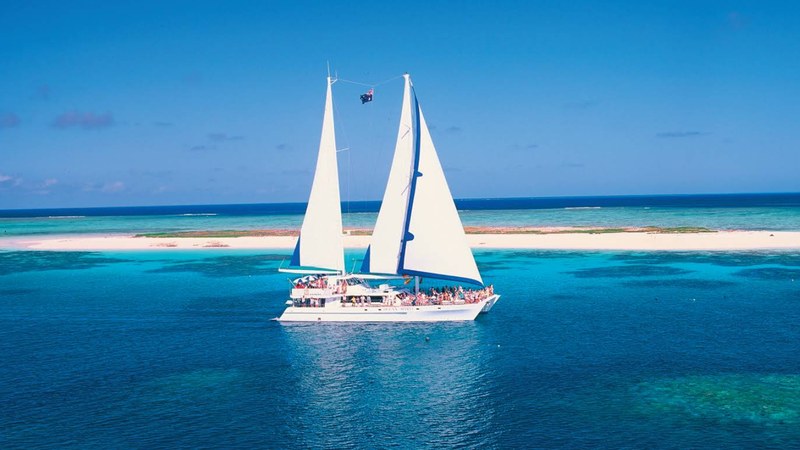
Ocean Spirit ~A$288
A sailing vessel that stops at Michaelmas Cay, a sand island and bird sanctuary in the middle of the reef.
- A sand cay and a seabird colony — a rare sight on the Cairns run
- Sailing itself forms part of the experience
- A calm lagoon, comfortable for hesitant swimmers
- One location for the day
- More wind-dependent than motor vessels
Best for: anyone who wants a beach and photographs as well as the underwater world. ★★★★☆
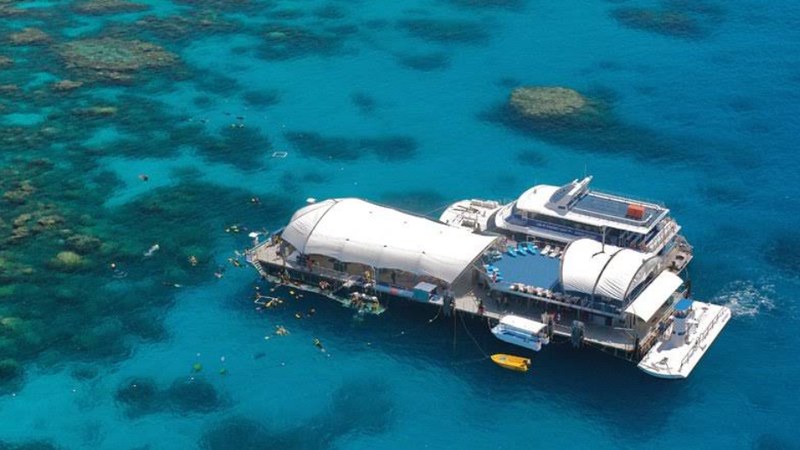
Great Adventures ~A$312-322
A pontoon on Norman Reef, plus separate programmes on Green Island.
- Norman Reef pontoon alongside Green Island options
- Underwater observatory and semi-submersible
- Half-day versions available
- A significant part of the day goes on transfers
- Large groups, with occasional complaints about organisation
Best for: visitors with one day who want to see an island and the reef together. ★★★☆☆
Quicksilver, Port Douglas ~A$338
A wave-piercing catamaran to Agincourt Reef — the furthest out and least trampled stretch of the outer reef.
- Sails in almost any weather — the lowest cancellation risk
- Agincourt Reef: ribbon reefs at the very edge of the continental shelf
- The largest and most established fleet in the region
- The highest fare in this list
- Departs from Port Douglas — add an hour on the road from Cairns
Best for: anyone happy to pay more for reliability and the best outer reef. ★★★☆☆
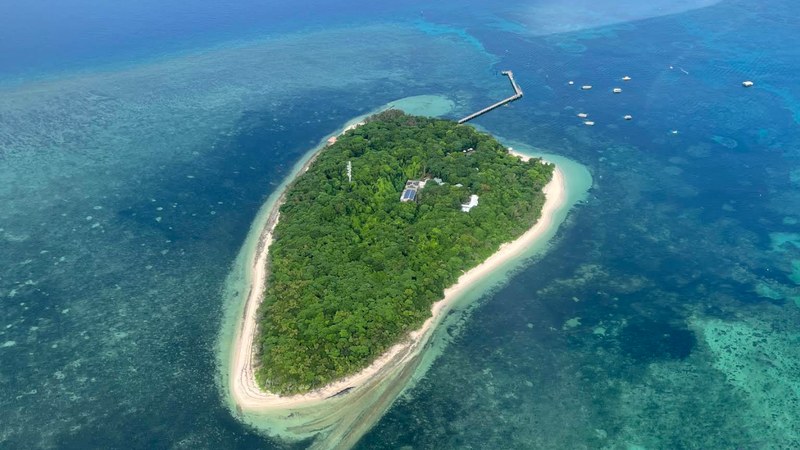
Green Island — a true coral cay ferry from A$122
A genuine coral cay: a flat little island of sand and coral rubble grown directly on the reef. White beach all the way around, rainforest in the middle, and you can walk the whole thing in about half an hour. The ferry takes roughly 45 minutes instead of ninety across open ocean. The most heavily marketed island out of Cairns — and, in our view, not the best one.
- Short crossing, far less seasickness than the outer reef run
- White sand and forest trails: plenty for small children
- Flexible — half-day and full-day options, with or without a glass bottom boat
- At low tide you cannot swim — the shallows drop to ankle depth and coral rings the island, so there is nowhere to wade out
- The free beach is small and has no shade; the shaded loungers and umbrellas are private and expensive
- The coral right off the beach is thin — the "home reef" has taken decades of mass visitation
- Water is often stirred up: a great many boats share one jetty
- Inner reef: visibility 5-10 m against 15-30 m outside
- Crowded in peak season; several attractions are paid separately
Our take: we do not send guests here — for the same money and the same travel time Fitzroy gives you considerably more. Choose Green Island only if a flat white-sand coral cay is specifically what you are after. ★★★☆☆
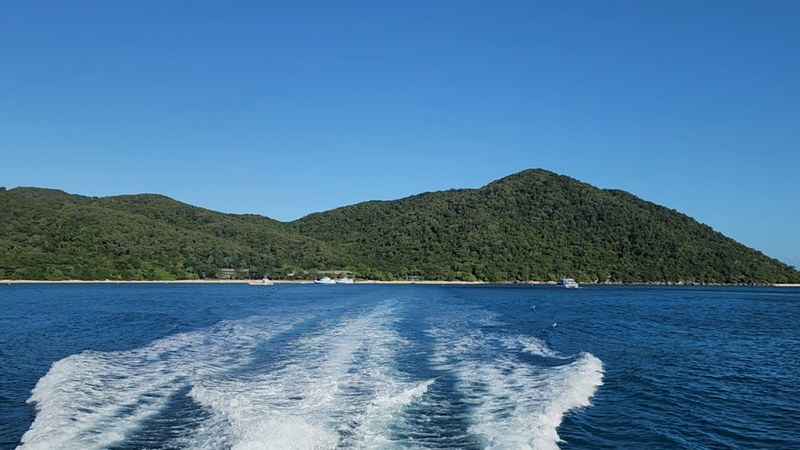
Fitzroy Island — hills and walking tracks ferry from A$67
An entirely different proposition: not a sand cay but a continental island — green hills under rainforest, tracks to the lighthouse and up to the summit lookout. The crossing is also about 45 minutes, but there is far more room here and it is easy to escape the crowd.
- You can actually swim, whatever the tide. The coral sits well offshore here, so the water stays deep enough to swim freely even at low tide — unlike Green Island
- The beach is genuinely clean, and Nudey Beach regularly appears on lists of Australia's best. The shoreline is coral rubble, but once you step in, the bottom is clean white sand
- Something to do beyond the sand: the climb to Summit Lookout, the lighthouse track, the Secret Garden inland
- Snorkelling straight off the beach, no boat needed
- Cheaper ferry than Green Island, and you can stay overnight at the resort or campground
- Coral rubble at the water's edge — reef shoes make getting in and out easier
- The tracks climb: the summit is hard work in the heat and you need water
- Same inner reef, so lower visibility than outside
- Fewer built facilities than a pontoon day
Best for: active travellers and couples who want a beach and a forest walk in the same day. ★★★★☆
Ferry fares are indicative 2026 return prices per adult: Green Island from A$122, Fitzroy Island from A$67 when booked early (the standard fare is around A$99). The EMC of A$8.50 and a fuel levy of about A$4 per adult and A$2 per child apply on top and are collected on the day of travel. Child fares run at roughly half the adult rate.
Departure: Reef Fleet Terminal
Almost every cruise leaves from one place — the Reef Fleet Terminal, 1 Spence Street, beside the Shangri-La hotel and The Pier shopping centre. Check-in starts early, between 7:15 and 8:00 am. Arrive 30 to 45 minutes before departure: each operator has its own branded desk where your voucher is exchanged for a boarding pass.
- The terminal has cafés, toilets and shops, including reef-safe sunscreen.
- For three people or more a taxi to the terminal usually works out cheaper than individual coach transfers.
- You must not fly for 18 to 24 hours after diving — plan your departure from Cairns with a margin, or you risk decompression sickness.
Seasickness: how not to ruin the day
The crossing to the outer reef takes over an hour, usually around ninety minutes, across open ocean — that, rather than the snorkelling, is the real test of the day.
The detail the brochures leave out. "It's calm on the reef" is only half true. It is calm inside the lagoon, behind the reef crest, where you actually swim. But the stretch between the reef and the pontoon, and the approach to it, is often anything but: there is swell and there is current. On a day with any sea running, an hour of that motion is quite enough to part you from your breakfast — and it happens out there, with a ninety-minute ride still to come.
Hence two practical rules: eat a light breakfast, nothing fatty or dairy, and take the tablet in advance rather than once you already feel unwell, because by then it barely works.
The rest of the prevention is simple and effective.
- Take something 30 to 60 minutes before boarding: Kwells or Travacalm (hyoscine hydrobromide), or an antihistamine such as Avomine. All are sold in any Australian pharmacy and usually on board as well.
- On the vessel sit outside in the fresh air, close to the centre of the hull — that is where the movement is least.
- Watch the horizon, not your phone and not the deck.
- If motion genuinely worries you, take a pontoon or an island trip: the crossing is shorter and calmer.
Outer reef or the islands
On the outer reef water clarity runs 15-30 metres and the coral is richer, but it is ninety minutes away. The inner reef around the islands is 45 minutes out with 5-10 metres of visibility, but you get a beach, rainforest and the option of simply lying down. An island day is the sensible choice for families with toddlers and for anyone in Cairns for a single day — and of the two we send people to Fitzroy, not Green Island.
The two islands themselves are different: Green Island is a flat coral cay with white sand, while Fitzroy Island is hilly with forest walking tracks. There is a full comparison of both in the cards above.
Our Cairns reef programmes
Great Barrier Reef Tour in a Small Group
Our own private-style reef day out of Cairns: the best snorkelling sites on the outer reef, a marine biologist on board, buffet lunch and all equipment included, with a glass bottom boat for anyone who prefers to stay dry.
See the small-group reef tour →
How we work. Tell us who is travelling, how confident you are in the water and how many days you have in Cairns. We match the vessel to the brief and the budget, quote the full amount up front with every charge included, and if the trip is cancelled we look for a replacement the same day.
We book the cruise for you. No wrestling with operator websites, seasonal fare tables and cancellation rules — we place the booking, send the voucher and explain exactly where and when to turn up. Payment terms are agreed in advance, with no surprises at the wharf.
Payment
We quote and take payment in AUD only. A deposit of 30% of the tour price secures each booking, and you should pay only after our confirmation email stating the exact amount. Card payments run through Square or PayPal, and bank transfer is available for larger bookings.
Full payment and deposit terms →
Frequently asked questions
What happens if my cruise is cancelled because of the weather?
The operator must offer a choice: a full refund, or a free transfer to another date or vessel. We look for a same-day replacement, normally on a larger boat that keeps running in that wind.
Why do some boats sail and others don't?
Wind decides, not rain. Below 15 knots everyone goes. At 20-30 knots the small yachts and catamarans carrying 20-40 passengers stay at the wharf while the larger vessels operate.
What does a reef day cost in 2026?
Roughly A$300-360 per person for the outer reef, from about A$196 on the budget dive boats, plus the A$8.50 EMC and a fuel levy of around A$10 per adult. During stinger season add about A$10 for a protective suit.
I can't swim. Is it worth going?
Yes, if you choose a pontoon: the underwater observatory, glass bottom boat, semi-submersible and children's pool let you see the reef without entering the water at all.
When is the best time to visit the reef?
From May to August the south-easterly trades blow at 15-20 knots — the crossing is bumpy, but the lagoon water on the reef itself stays calm, particularly at low tide in the middle of the day. Between November and May stingers are present, so protective suits are issued.
Can I fly straight after diving?
No. You need 18 to 24 hours between your last dive and your flight — a safety standard every operator observes.